
Xie Xie Pronunciation
You’ll say 谢谢 (xièxie) a lot in China: to the waiter who brings your noodles, to the cab driver at the end of the ride. It means “thanks,” and it’s only two syllables.
Many English speakers start it with an English sh, as in “shay-shay,” and to a Chinese listener that’s a different sound. Hit ▶ to listen, then record yourself. The widget can show whether your x came out as sh, and which tone you used.
What does xiexie mean?
谢 (xiè) means “to thank.” Double it and you get the everyday “thanks.” You’ll find the word written a few ways:
- xièxie, standard pinyin. There’s no mark on the second xie, since it’s said light and toneless.
- xie xie or xiexie, the same word without marks, as people type it in a search bar.
- hsieh-hsieh, from an older way of spelling Chinese. You’ll still see it in family names like Hsieh, which is the same 谢.
Pinyin uses x for a sound English has no letter for, so reading it the English way will steer you wrong. Wondering what to say back? The thank you page has the usual replies.

Where does your voice go?
Start xiè up high and let it drop all the way down, like a flat “nope.” Then let xie rest at the bottom, short and relaxed, the way your voice settles at the end of a sigh. In the picture below, 5 is the top of your voice and 1 is the bottom.
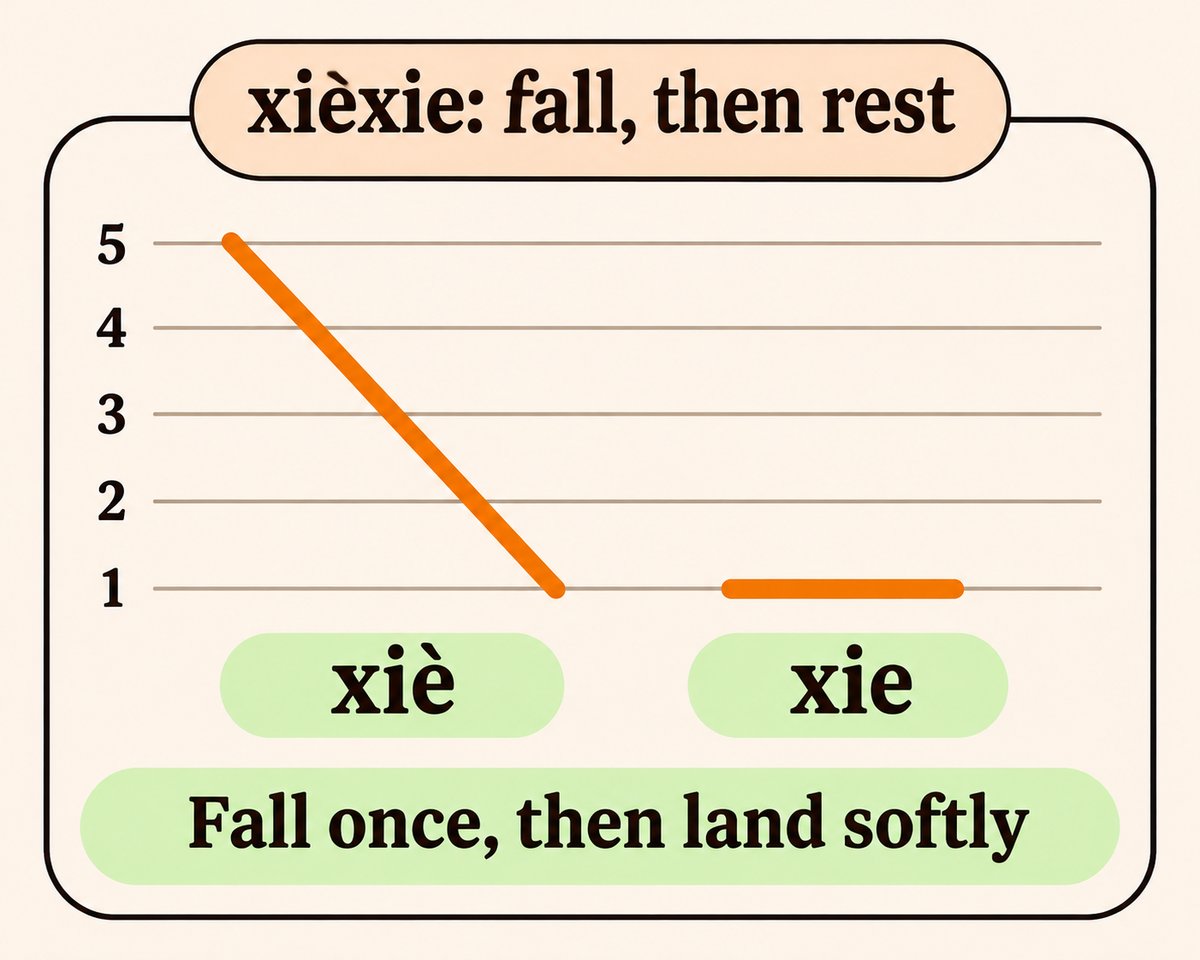
To hear that fall next to the other three tones, open the tone chart, which plays them in pairs. 再见 (zàijiàn) falls the same way on both syllables, so once xiè feels right, goodbye is a good next try.
Why does the tone matter so much?
Keep the sound xie and change only the tone, and you get four different words:
- 些 (xiē), high and level, as in 一些 (yìxiē), “some”
- 鞋 (xié), rising, “shoe”
- 写 (xiě), low and dipping, “to write”
- 谢 (xiè), falling, “to thank”
So if your 谢 rises, it sounds like 鞋, “shoe.” In a shop or a restaurant, people will probably still get what you mean, but the right tone saves them the guesswork.
Drill the tone with three words
- Type 鞋 into the box above, record it and check that the widget hears a rising tone.
- Do the same with 写 (low and dipping) and 谢 (falling).
- When all three come back right, go back to 谢谢 and keep the second syllable short and light.
Shay-shay, zie-zie, she-she: what’s off
These spellings turn up all over the internet, and each one gets something wrong:
- “Shay-shay” uses an English sh and swaps the vowel for the “ay” in “day.”
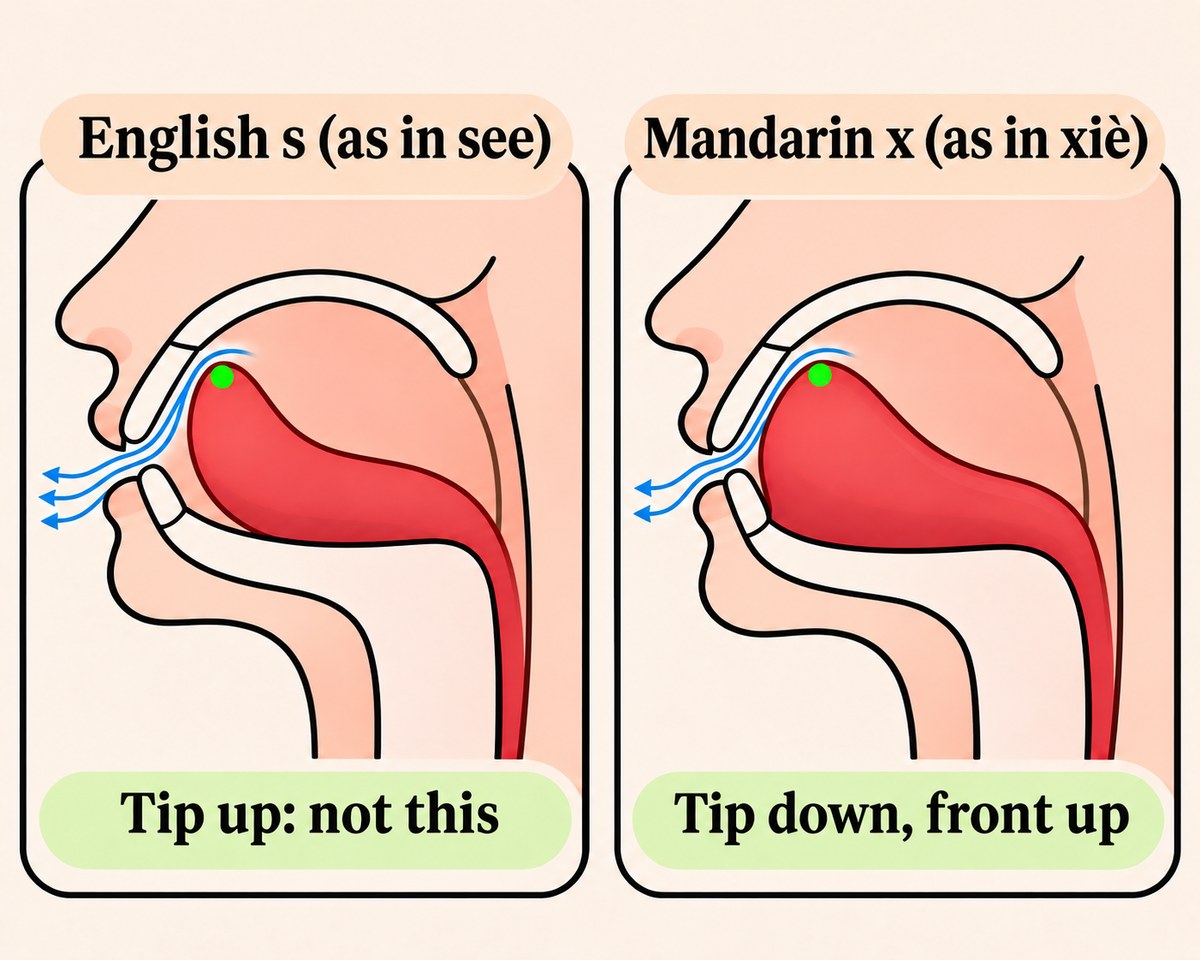
- “Zie-zie” and “see-yeh” use an English z or s, where the tongue tip usually points up behind the top teeth. For Mandarin x, the tip rests behind your lower front teeth and the middle of your tongue rises.
- “She-she” uses an English sh and drops the final “eh,” which turns xie into xi, as in 西 (xī), “west.”
For more practice on the x itself, the xu page drills the same sound, and the thank you page walks through it step by step.
The xia page pairs the same x with “ya,” and the qin page covers q, which shares that tongue position but comes out with a puff of air. If your x still sounds like sh, the zh, ch and sh guide puts the two side by side.