
Relax Your Jaw for Chinese Pronunciation
Your jaw: why it still isn’t working even when you get it all
When I started learning Chinese, I ran into a problem with a tense jaw. It feels like you’re saying things correctly, but the sound comes out unnatural, and something around your teeth starts to ache, like your muscles after lifting weights at the gym.

A few months into the language, you can feel like you know where your tongue goes and move freely through zhi chi shi zi ci si, and still sound wrong somehow. A tense jaw may well be the reason.
An adult’s jaw is almost always tense: work, stress, you name it. A tense jaw physically robs you of at least a third of the sounds you could pronounce correctly, no matter how well your tongue is doing its job.
Here’s how I relaxed mine: I imagined I was a zombie. Here are the details:
- From 2012 to 2014, one of my favorite shows, The Walking Dead, was at the height of its popularity, and I watched it regularly in my spare time.
- If you’ve seen it, you know the show has plenty of zombies whose jaws hang loose (I tried to put that as gently as possible, haha). They’re pretty chill guys in general, too, if you leave them alone.
- Then one day, while I was looking for a way to relax my jaw, my brain came up with a brilliant solution: try copying those guys from the show.
- So I tried it. I actually pictured myself as a zombie wandering alone through the deserted streets of a postapocalyptic city, with my jaw relaxed and my eyes half closed.
- I don’t envy anyone who saw me like that (I hope nobody did), but it really helped. I learned to relax my jaw.
A different method might suit you better. I’m just sharing what worked for me, lol. You can look up a less extreme way to relax your jaw online and try that instead.
Your consonant is too polite
Now for something more advanced: the thing I only figured out years later, and it solves half your problems at once.
- An English consonant and a Chinese consonant are two parallel universes. In English, a consonant is just a way to start a sound. It feels polite and economical.
- A Chinese consonant is a kung fu strike. It creates a barrier, builds up air behind it, and throws that air into the vowel.
Think of a dam: you build up the sound, then you let it go.
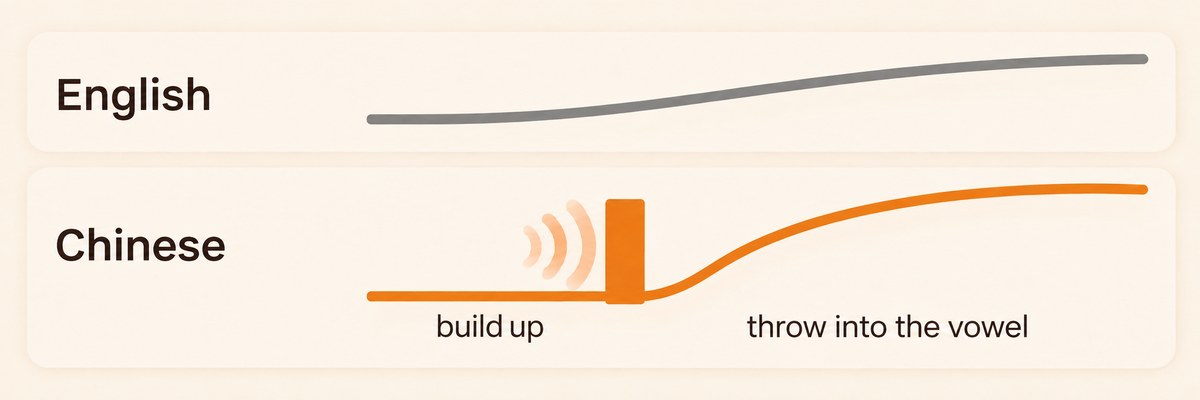
Once the consonant has that support, tones start coming more easily on their own. Your larynx adjusts for the tone during the consonant itself (before the sound even starts). A “weak” consonant leaves less time for that adjustment, so the tone comes out blurred. For the sound to come out clear, the consonant needs time to get going.
You can spend months fighting the third tone when the real problem is the consonant before it.
Here’s an interesting observation: back when I was teaching Chinese full time, I found that my students made several times as many mistakes with tones as they did with sounds.
Yet most of the questions I got were about sounds. People hardly ever ask about tones.
That leaves you in a curious spot: you fight the problems you can hear and stumble over the ones you can’t.
When someone else says a word with the wrong tone, you usually catch it. Your own off-key tone is harder to hear simply because nobody has pointed it out to you.
A quick note about aspiration: the puff of air in c, ch, and q is stronger than you’d think. These are the same hard-hitting consonants from the previous section.
If you grew up speaking English, this isn’t your main problem: English has its own aspiration, and sometimes that helps. But if a syllable sounds weak, start here.
Exercises that helped me
This is all simple and boring, like most of the phonetics basics (by the way, thanks for reading this far, you’re my hero).
- “Zombie”: jaw down, eyes half closed, all the tension out of your jaw. These days, I’d suggest looking into some proper relaxation techniques.
Many years later, I learned that this method has a name: the Froeschels method. Meerschman and colleagues tested it in 2016, and the people who chewed and talked at the same time ended up with steadier voices.
I can’t promise this method will improve your pronunciation, but I think it may help release tension in your jaw if you use it alongside the other exercises.
- Wine cork: grab an ordinary cork and hold it between your teeth. Don’t bite down too hard. It should just stick out of your mouth. Whatever you do, don’t choke on it. Be careful not to block your airway, and keep the cork clean.
With the cork in place, practice simple syllables, keeping each one clear. Skip the fricatives, and skip j and q too: it doesn’t work with them.

Here’s the point. The cork is an obstacle, and for the syllable to get past it, the consonant really has to push.
Then take the cork out of your mouth and try again without it.
Why go to all this trouble? You can’t control the force of a consonant just by thinking about it. You can’t feel whether you’ve pushed hard enough. The cork makes it something you can actually feel.