
HSK Levels
The HSK exam is the main test of Chinese language skills. You can compare it to IELTS or TOEFL for English. This exam is most often used for:
- getting into Chinese universities with a scholarship
- getting a job
- showing your language level if you teach Chinese.
When I took the HSK and HSKK exams in 2015-16, they did not really focus on speaking as much as they do now. In the updated version, the speaking part is much more detailed, and students have to meet higher standards.
Many of my students told me that during the exam, the examiner pays attention to the pronunciation and tones of the people taking the exam. After hearing these stories, I decided to create a separate section on the site where you can practice your pronunciation and tones to prepare for the HSK exam.
I tried to make the materials on this page match the official requirements as closely as possible. Still, I suggest you mainly use the official HSK prep materials when preparing for the exam, and use my site for extra practice with pronunciation and tones so you can feel more confident and comfortable.
HSK levels and how many words each has
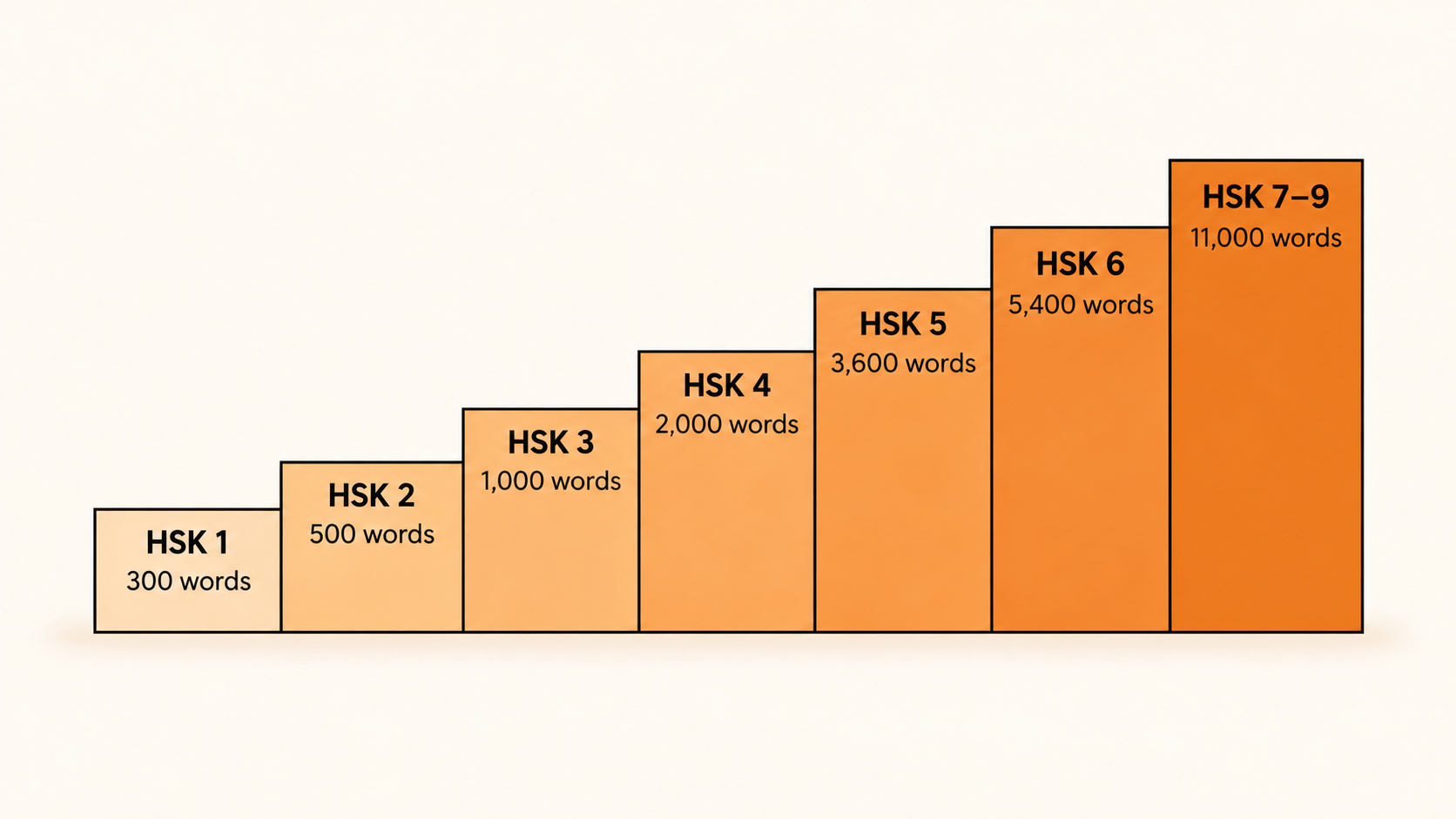
As you probably already know, the HSK exam used to have six levels, and now it has nine. The number of words required at each level has also grown. The table shows the numbers for the new version of the exam.
If you have been preparing for the new HSK format using old word lists, note that the new version has more words starting at the very first level. Below, you can see how many new words each level has and how many words there are in total.
| Level | New words | Total words |
|---|---|---|
| HSK 1 | 300 | 300 |
| HSK 2 | 200 | 500 |
| HSK 3 | 500 | 1,000 |
| HSK 4 | 1,000 | 2,000 |
| HSK 5 | 1,600 | 3,600 |
| HSK 6 | 1,800 | 5,400 |
| HSK 7–9 | 5,600 | 11,000 |
- HSK 1 lets you have basic conversations in simple everyday situations. For example, you can greet your Chinese friends, ask how they are, ask how to get to the library, and so on.
- HSK 2 covers a slightly wider range of basic communication in daily life and at school. You can buy simple things, find your way around when traveling, and ask someone basic questions about their family.
- In my view, the first major level is HSK 3. This is when you can discuss hobbies and basic work topics, and communicate fairly well at school, at work, and in daily life.
- HSK 4: at this level, you can start discussing the news and share your opinion quite confidently.
- HSK 5: you can read the news on your own and write simple essays.
- HSK 6: you can communicate quite fluently in a work setting.
- HSK 7–9 is the level of professional translators, I think. You need it for detailed discussions in a specialized field. Maybe in science. In theory, you can also talk about more abstract topics, like philosophy, art, and so on.
The HSKK speaking exam
Common questions
- How is the new HSK 3.0 different from the old one?
The old HSK has six levels, and the new one has nine: levels 7-9 have been added after level 6 as one combined level. Each level has more words, with 300 at the first level. The new version officially starts worldwide on December 13, 2026.
- Which version should I prepare for?
If you are taking the exam on December 13, 2026, or later, prepare using the new syllabus. It was published in November 2025 and has been in effect since July 2026. When you register, check which version is listed for your test date.
- Where can I find the official word lists?
In the official exam syllabus on chinesetest.cn: open the HSK3.0 menu, then Examination Syllabus. You can also find topics, characters, and grammar for each level there.