
Learn Pinyin
Why we need pinyin
Pinyin was first created by Zhou Youguang to help Chinese people learn to read and write. As you can probably guess, Chinese characters were and still are hard to learn for both foreigners and Chinese people themselves. This system helped people read and understand Chinese words without knowing the characters.
Today, pinyin is most often used for:
- typing: when I first started learning Chinese and didn’t know about pinyin, one question kept bothering me: how would I type Chinese on a keyboard?
I pictured something like this:
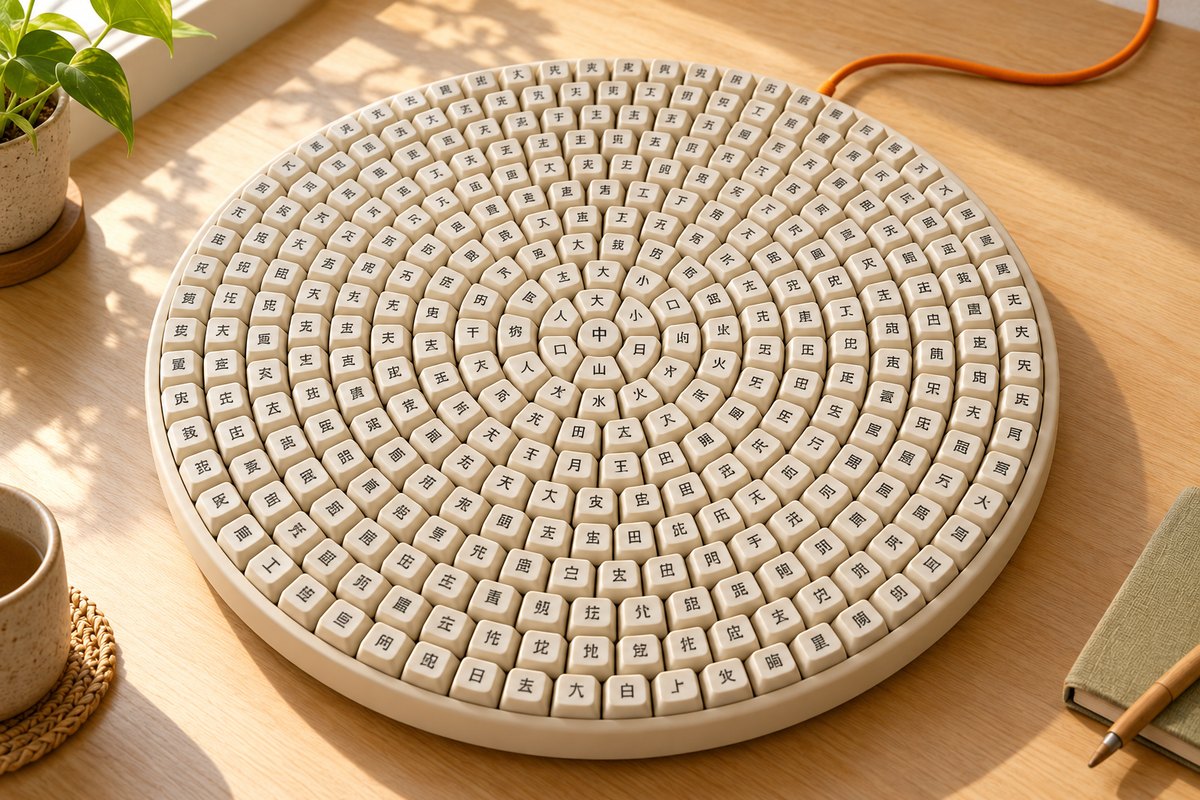
I was already rubbing my hands together, thinking how cool I’d look once I bought a keyboard like that and could type fast on it.
To my disappointment, it turned out to be much more ordinary: if I want to write “hello” in Chinese, for example, I just type “ni hao” with Latin letters on my laptop keyboard, and the pinyin system kindly puts in the right characters, 你好, for me.
It does seem handy, but then again, imagine how cool that keyboard would look, not to mention the person who knew how to use it (15 years later, I still can’t let go of that thought).
- looking words up in dictionaries: in textbooks and dictionaries, pinyin appears next to a character to show its pronunciation and tone. This one’s pretty clear.
- writing Chinese words for international readers: you’ll also often see pinyin in the news for Chinese city names (for example, 青岛 Qingdao). If an article is meant for a wide audience, the tone marks are usually left out. In a specialized publication or a research paper, the tone marks are usually included. For example, 国家 guo2jia1.
- helping foreigners learn Chinese pronunciation: pinyin helps beginners understand how to pronounce Chinese sounds and tones faster. I see pinyin as a kind of “crutch” for people learning Chinese pronunciation.
At the start (usually the first 6 months), you can and should use it. After that, I strongly recommend slowly moving away from it until you’re reading characters on their own.
This will be hard, and your brain will fight it every way it can. But it’s one of the main things that will help you make progress later. It’s important to be able to read Chinese characters as they are, without pinyin, because you rarely see pinyin in the real world.
So, use pinyin only at the start and for pronunciation practice. After about 6 months, slowly switch to reading characters.
- helping children learn Chinese in kindergarten: I was once surprised to learn that Chinese children struggle with characters too (I thought they were born with at least HSK 3 characters already in their heads).
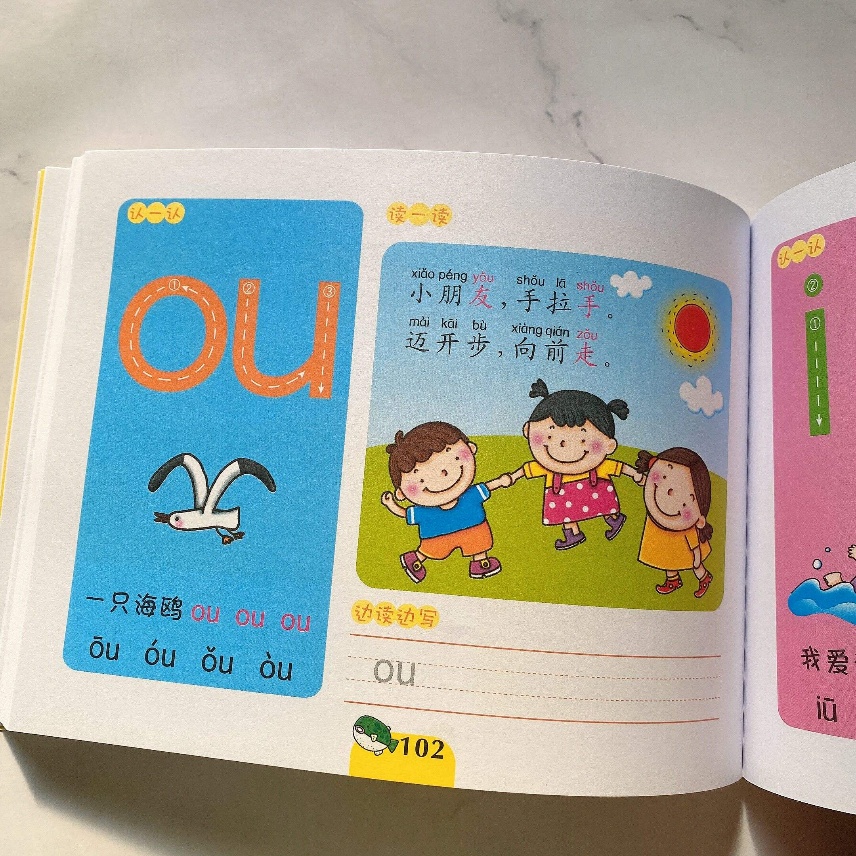
How do you use the pinyin chart?
Step 1: listen to the syllable: choose a tone above the chart, tap a syllable, and listen. Make sure you actually listen instead of just skimming the syllables. Try to connect what you hear with the syllable you see in the chart.
⚠️ Be careful! It’s easy to make a mistake here and read pinyin syllables as if they were English sounds. You need to train your brain to make this connection: I see pinyin, so I read it using Chinese pronunciation rules, even though the Latin letters look familiar.
You can listen to podcasts every day and still just be fooling yourself. Your ear will never learn on its own because it relies on how you make sounds yourself.
Step 2: tap the microphone and say the syllable: it’s important to speak slowly and not be afraid of looking like a five-year-old. Once you say the syllable, the chart will give you feedback.
Heads up! The chart won’t tell you that you said it “wrong.” It will give you more detail, something like “you needed to say sh, but we heard s.” This detailed feedback will help you understand where to move your tongue.
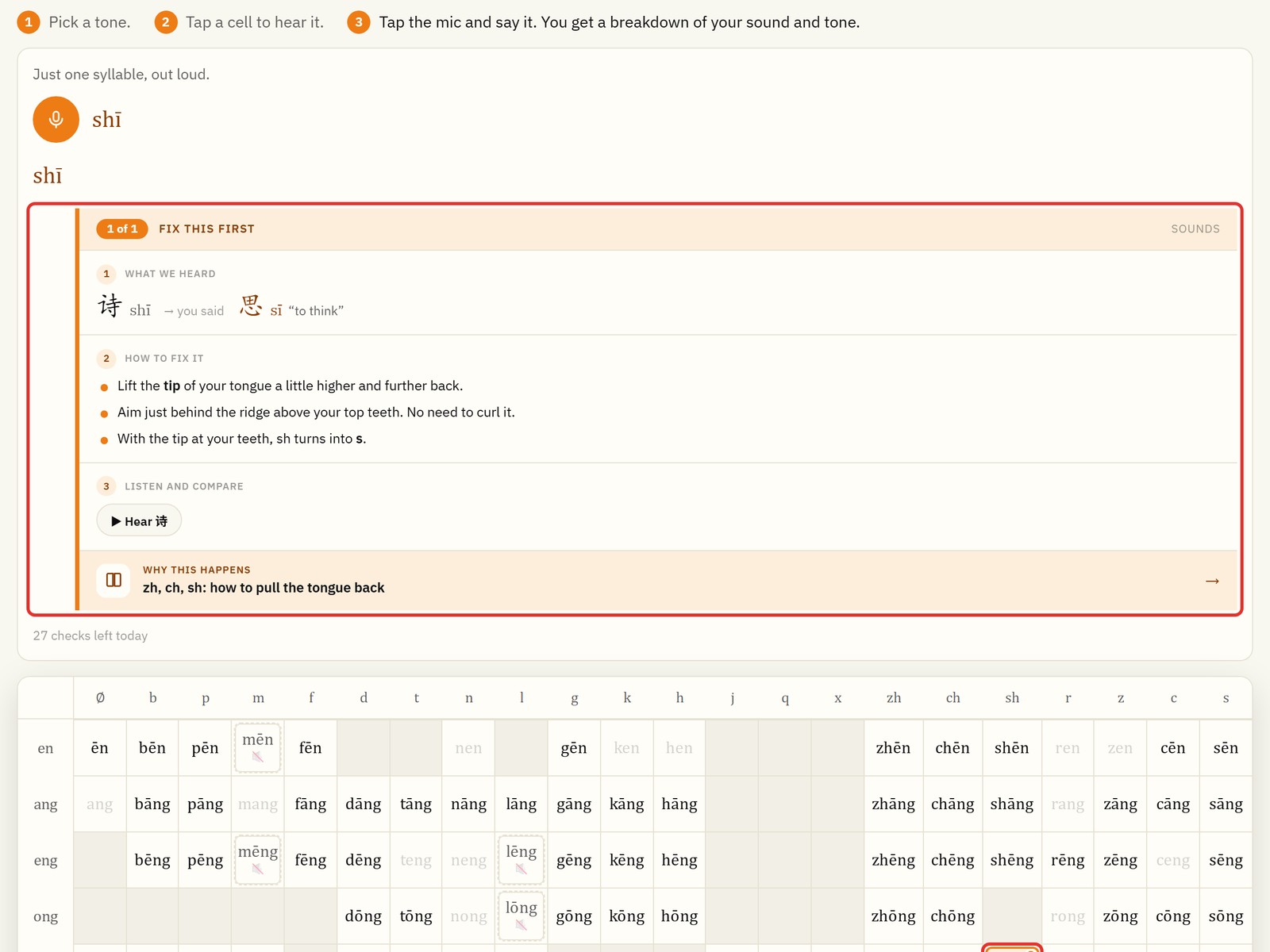
Step 3: practice for 10-15 minutes, and don’t worry about losing your progress: our chart remembers where you left off, what you got right, and where you made mistakes. You don’t need to learn everything at once. I’d recommend spending no more than 10-15 minutes a day practicing with this chart.
Beginner mistakes and how to avoid them
The main mistake beginners make is trying to read pinyin using English pronunciation rules. Your brain practically whispers in your ear, “You know these letters.”
Another important sound to look at on its own is ü. It hardly exists in English, and your brain does its best to replace it with something familiar, usually u or i.
And that’s where mistakes happen.
Here’s how to make it: put your tongue exactly where it goes for i, and shape your lips as you would for u.
Just two movements, each of which we make hundreds of times a day, but never at the same time!
The hard part is putting them together. The sounds on their own aren’t the problem.
Many of my students made mistakes here: the syllables ju, qu, xu are written with u, but the sound should be ü.
The thing is, a real u never comes after j, q, or x! The dots are left out. The reason is spelled out in the 1958 pinyin rules, and you can WORK OUT the rule instead of memorizing it:
- the dots are removed where u is never possible: after j, q, x, and y;
- the dots are KEPT where both are possible: after n and l, as in nù/nǚ, lù/lǜ.
The reason is stated right in the rules: “to make the writing shorter.”
But you still need to read it as ü.
That’s why xu isn’t “zoo” or “ksoo,” but something new that we haven’t come across before.