How Do You Pronounce Goodbye in Chinese?
Zàijiàn, báibái and the goodbyes people use every day
The textbook way to say goodbye in Mandarin is 再见 (zàijiàn), literally “see you again.” Both of its starting consonants work differently from English, and most learners slip on one of them.
再见 is already in the box. Tap ▶ to hear it or 🐢 to slow it down, then tap the microphone, say it, and tap again to stop. You’ll get a result for each syllable and its tone. Any other goodbye from this page can go in the box too.
How to pronounce zàijiàn, compared with English
- Z is like the “ds” at the end of “kids,” not the buzzing z in “zoo.” You should hear a tiny d before the hiss.
- The ai is like the English word “eye.” Nothing to change.
- J is like the j in “jeep,” but the tip of your tongue rests behind your lower front teeth and the middle of the tongue presses up. Keep your lips spread, not pushed forward.
- Ian in jiàn is like “yen,” not “yahn.” The a sounds like the e in “yes.”
- Both syllables have the fourth tone. In a pair like this, the first fall is a bit shorter, and the full drop comes on jiàn.
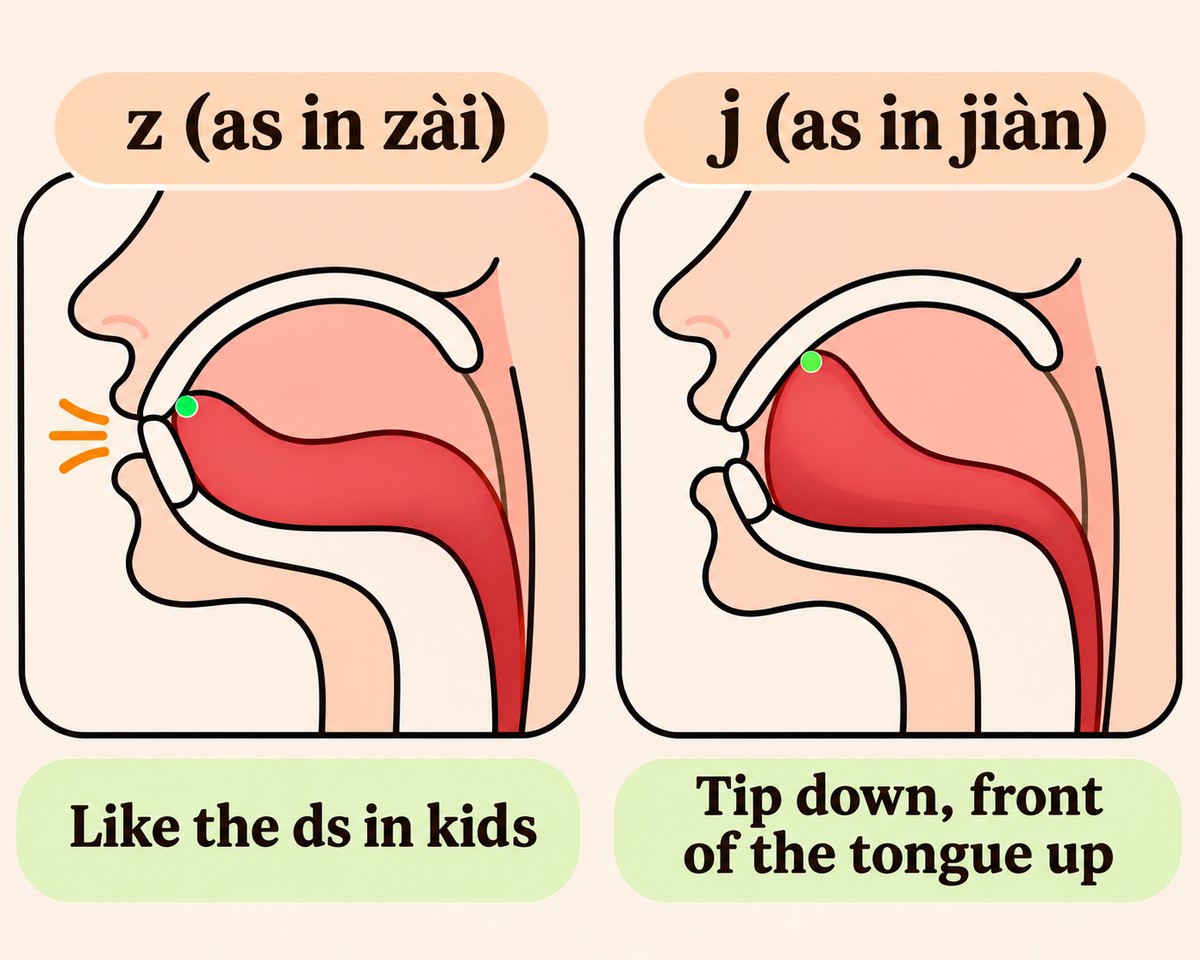

The z and j belong to a set of nine Mandarin sounds that English speakers often confuse. The zh, ch and sh guide shows how they line up.
Other ways to say goodbye in Chinese
再见 is correct everywhere, but it’s less casual than 拜拜. You’ll also hear these:
- 拜拜 (báibái or bāibāi) is bye-bye, borrowed from English, and probably the most common goodbye among friends and on the phone.
- 回头见 (huítóu jiàn) means see you later.
- 明天见 (míngtiān jiàn) means see you tomorrow.
- 晚上见 (wǎnshang jiàn) means see you tonight.
- 下次见 (xià cì jiàn) means see you next time.
- 保重 (bǎozhòng) means take care. It’s for a longer goodbye, when you won’t see the person for a while.
- 一路平安 (yí lù píng’ān) means have a safe trip. 一 is yī in the dictionary, but before a fourth tone it changes to yí.
- 慢走 (màn zǒu), literally “walk slowly,” is what a host says to a guest who is leaving. Shop staff say it to customers too.
When you’re the one leaving, skip 慢走 and say 我先走了 (wǒ xiān zǒu le), “I’m heading out.”
Common mistakes English speakers make
- A buzzing “zzzai-jian” sounds wrong. Start the z with a short d.
- In ian, the a sounds like the e in “yes,” so it’s “jyen,” not “jyahn.”
- English speakers often end a goodbye on a friendly rise. In 再见, both syllables fall.
- 再见 is never wrong, but 拜拜 and 明天见 sound more natural with friends.
Next, learn how to say hello, thank you and my name is in Chinese.
Check yourself
Try see you tomorrow
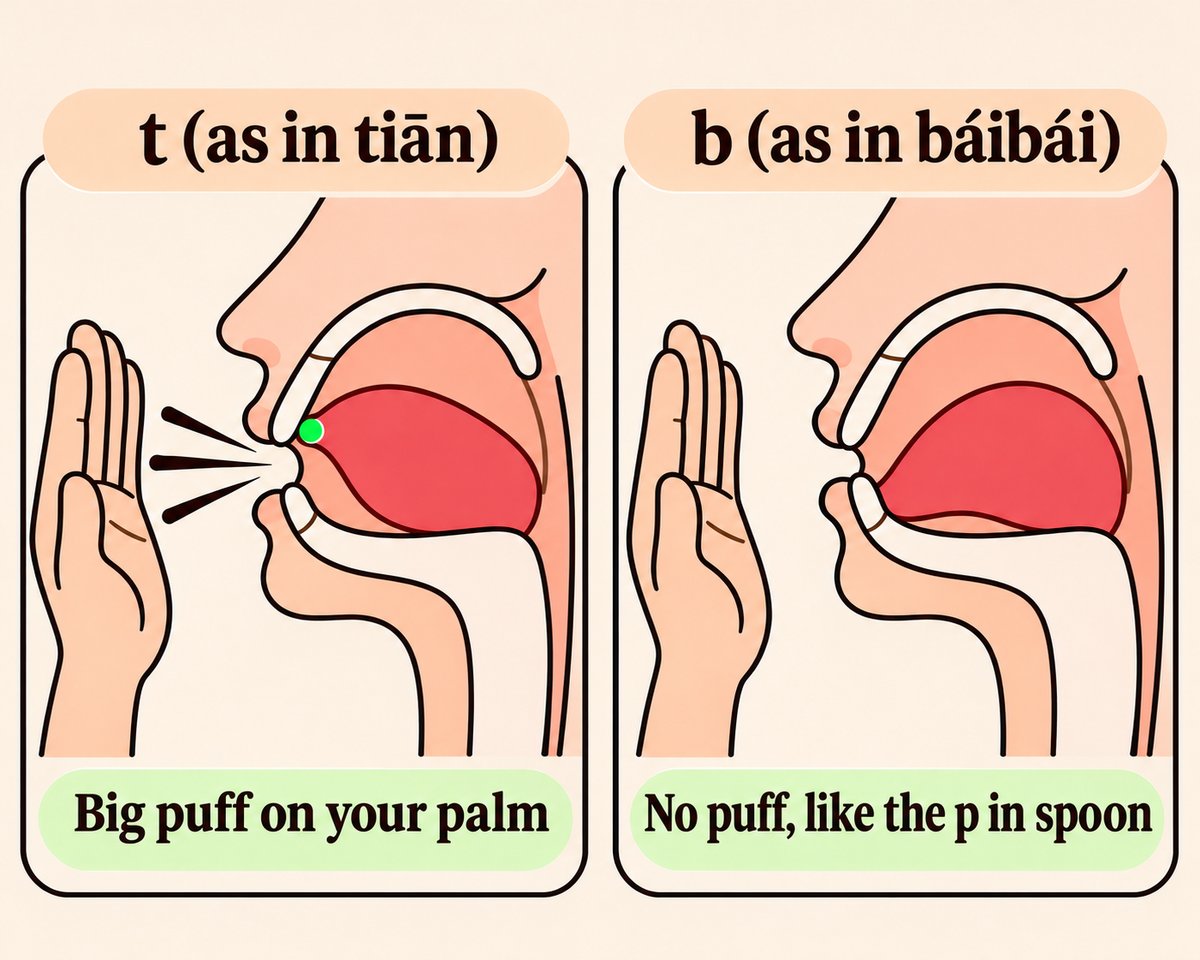
Replace 再见 with 明天见 and record it. Míng rises, tiān stays high and level, and jiàn falls. If míng comes out flat, start it lower. The t in tiān is like the t in “top,” but with an even bigger puff of air. Hold your hand in front of your mouth and you should feel it.
Then try 拜拜 (the widget checks báibái). Its b is like the p in “spoon,” with no puff of air. 拜拜 is lighter and more casual than 再见.