
Chinese Reading Practice
On this page, you’ll find Chinese reading exercises. Reading is a very important part of pronunciation practice. You might say individual syllables well, but once they turn into a full sentence, you can make a lot of mistakes because the tones change.
You need to keep a rhythm and use the right intonation. That’s why, about a month into learning, I usually tell all my students to start reading simple sentences right away. You’ll find about 1,000 of these simple sentences on this page.
They’re fairly simple. After you read them, you’ll also get feedback from our AI system, so you can adjust your pronunciation and Chinese tones where you need to.
I believe this section of the site will be especially useful if you’ve already learned basic Chinese pronunciation syllable by syllable. It can help you speak more fluently and improve the overall rhythm of your sentences.
I strongly recommend practicing for at least 5 minutes a day: read sentences, get feedback, and work on your mistakes.
How to practice: three steps
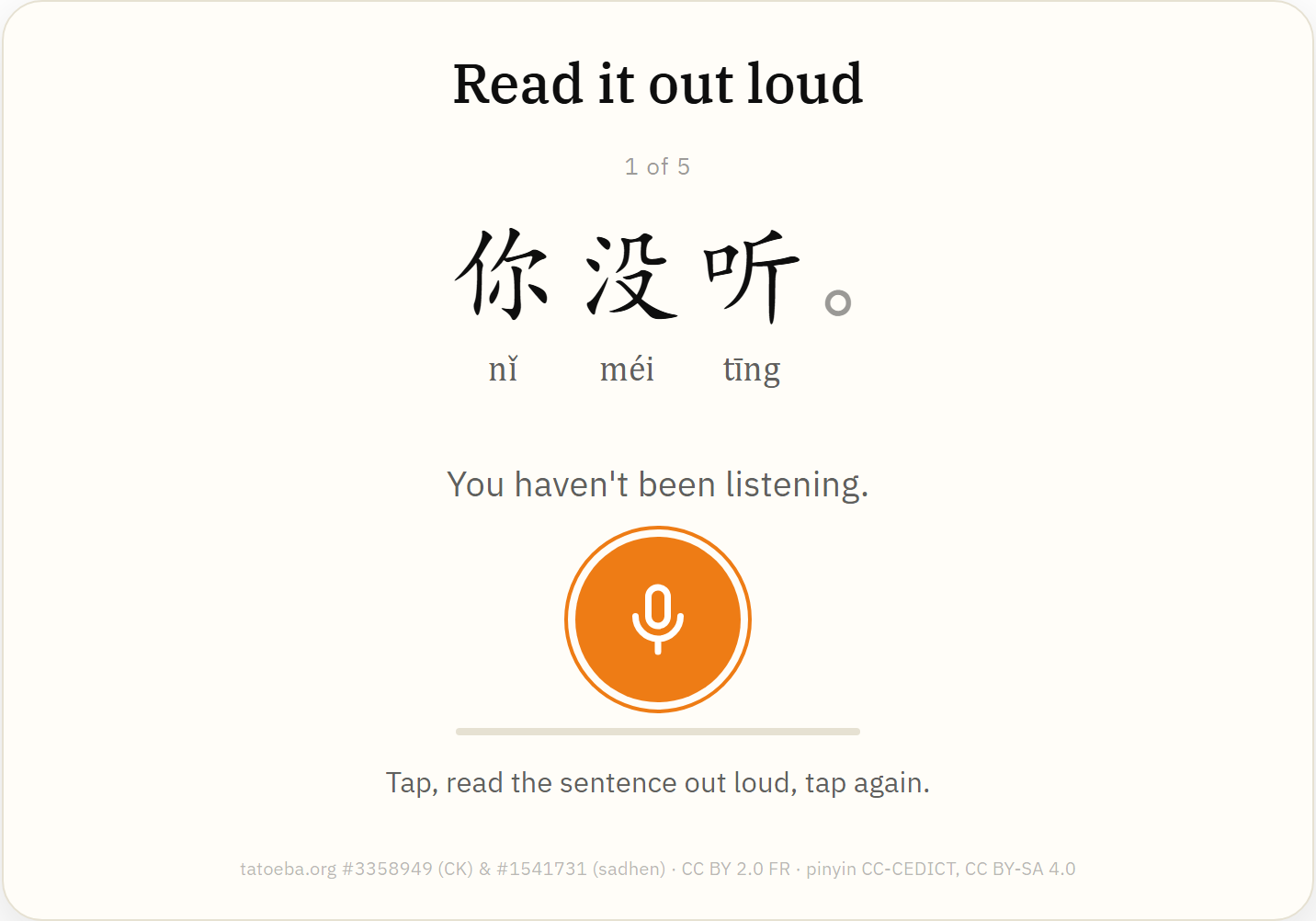
- Press the microphone button and read the phrase aloud (tap it once to start recording and again to stop, on your phone or your computer).
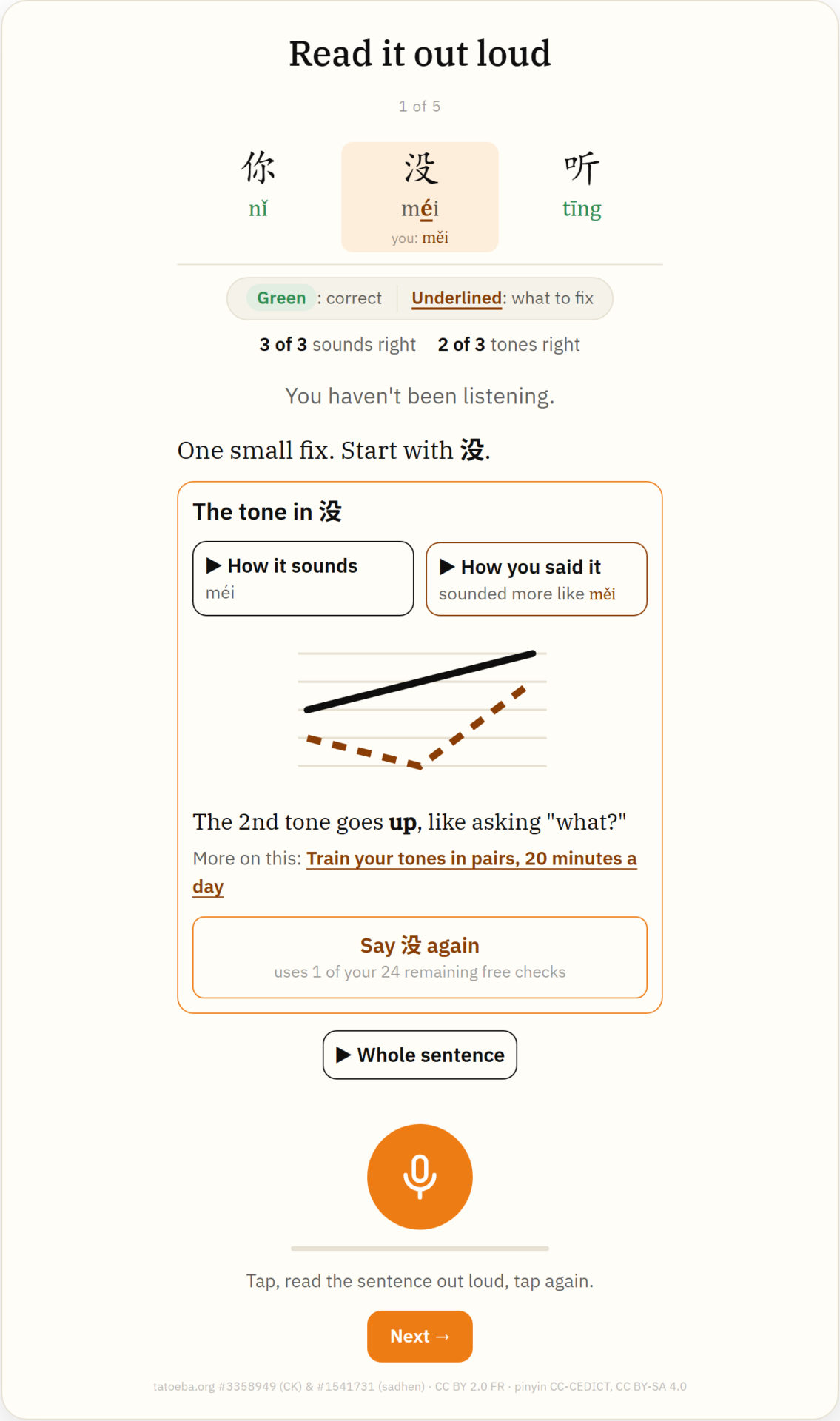
- You’ll see feedback on your pronunciation. Green shows what you said correctly, and a brown underline marks mistakes you need to work on. You can also expand some sections: click the flashing orange arrow to learn more. And you can listen to your recording, listen to the sample, compare the two, and say it again.
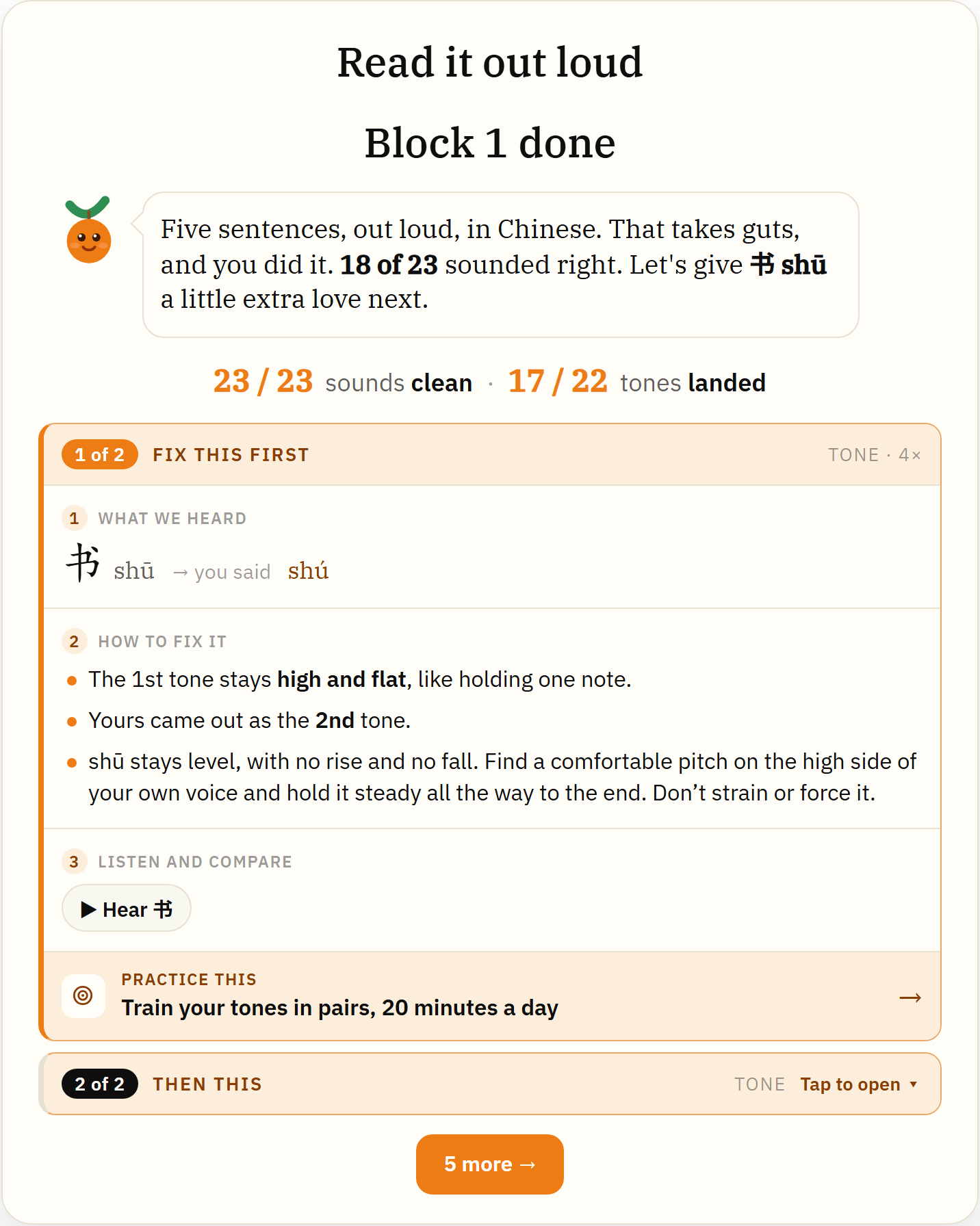
- After 5 phrases, you’ll see a “5 more →” button at the bottom. These 5 sentences are picked based on your own mistakes, so I recommend giving it another try to get two rounds in.
Sample sentences to read
| Characters | Pinyin | Translation |
|---|---|---|
| 我要回家。 | Wǒ yào huí jiā. | I want to go home. |
| 我在读书。 | Wǒ zài dú shū. | I’m reading. |
| 他明天有空。 | Tā míngtiān yǒu kòng. | He will be free tomorrow. |
| 大鱼吃小鱼。 | Dà yú chī xiǎo yú. | Big fish eat little fish. |
Sentences: Tatoeba (tatoeba.org), CC BY 2.0 FR: #256506 (CK) & #834800 (Martha) · #1349059 (sacredceltic) & #5640765 (verdastelo9604) · #304092 (CK) & #833018 (Martha) · #7772868 (sharris123) & #464946 (fucongcong)
My mistake: spending too long on individual syllables
When I was learning Chinese, I made a small mistake that I later regretted: I spent more time practicing individual syllables than I needed to. Honestly, looking back, I realize I was just plain scared to move past syllables and start reading full sentences.
They seemed very difficult. I didn’t understand how tone sandhi rules worked, and they wouldn’t stick in my head: when I saw two third tones, I read them as two third tones. So I could pronounce syllables well on their own, but when talking with Chinese people, the moment things went even slightly off script, I ran into trouble.
I had trouble because I lacked a foundation in reading sentences. I didn’t have ready-made chunks in my head that I could serve up a portion at a time. In food terms, I had chopped ingredients, but no simple finished dish.
That’s why it’s so important not to be afraid of the sentences in this section of the site. They’re fairly simple, but they become very useful once you start using them when you speak.
One more tip: don’t just read the sentences, try to memorize them, because they’ll pop up as ready-made phrases in real conversations with Chinese people.
This is especially true for phrases you use all the time in everyday life, such as “I want to buy this,” “I want to order this dish,” “I need to use the bathroom,” and so on.
What you’ll get
- You’ll be able to practice reading Chinese sentences and get feedback from our AI system on your tones and other aspects of pronunciation.
- It’s free, with no signup required.
- The only catch: you get up to 30 checks per day across all tools combined. Each check costs us money, and we’re a new project, so we can’t offer more yet.
- You’ll be able to listen to yourself and compare your pronunciation with a model reading by an automated voice.
Frequently asked questions
What level do you need?
The phrases in this section of the site are chosen for beginners, roughly HSK 1–2. The sentences are short too, about 3–6 characters each. At this stage of the project, you can’t choose a level, but we may add that feature in the future.
Does the feedback catch tone changes between words?
Within a single word, yes. Between two words, not always yet: sometimes the system expects the dictionary tone.
Do you store my voice?
No, we don’t store your voice.
What do you need to start practicing?
You need a browser and a microphone on your phone or computer. You don’t need to install a separate app.
How long should you practice each day?
We recommend at least 5–10 minutes, as long as it’s every day.
Try it in 1–2 minutes
I recommend you start practicing right now. It’s very easy and takes just 1–2 minutes of your time, and you’ll get your first result and see what to work on.