
Zh Ch Sh Pronunciation
Six syllables that sound the same
In my second month in Beijing, I got lucky. I made a Chinese friend.

He was learning English, I was learning Chinese, and we immediately bonded over how hard it is to learn a foreign language.
Even now, I sometimes picture his face as he slowly pronounced the syllables zhi chi shi zi ci si.
The poor guy was trying his best, but my foreign ears heard two syllables, each repeated exactly the same way three times in a row (zhi and zi). My friend insisted they were all different syllables, and I honestly thought he was trolling me.
When I learned to tell the syllables apart by ear, at first zhi sounded like chi to me, and zi sounded like ci.

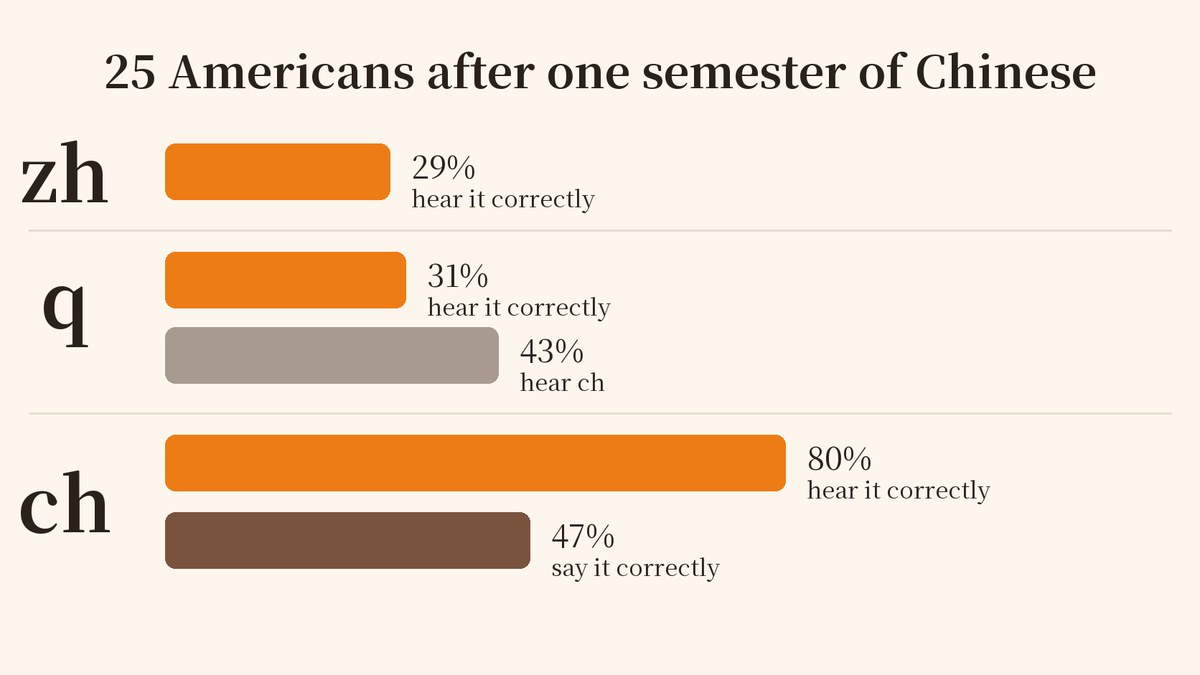
Now, looking back and having studied pronunciation in depth, I understand that these sounds are difficult for a lot of learners. Below are a few findings from an interesting study (Wang and Chen 2020) that assessed the pronunciation of 25 Americans who had studied Chinese for one semester:
- zh: 29% hear it correctly. Most often, they hear it as j.
- q: 31% hear it correctly. 43% hear it as ch.
- ch is heard correctly by 80%, but pronounced correctly by only 47%. More evidence that hearing and speaking are two different skills.
According to the study, 84.5% of all pronunciation errors in this assessment involve the nine sounds (zh ch sh, z c s, j q x) I’ll cover in this article.
How I ended up in Beijing in the first place, and why I arrived with a decent foundation in phonetics but no speaking skills, is another story.
The spectrum: three tongue positions
We’ve reached the main point of this article. In this section, I’ll share one realization that helped me make progress early on.
The basic idea is that zhi chi shi zi ci si j q x aren’t nine separate sounds. They’re one spectrum and three positions.
Below is a picture showing the spectrum.
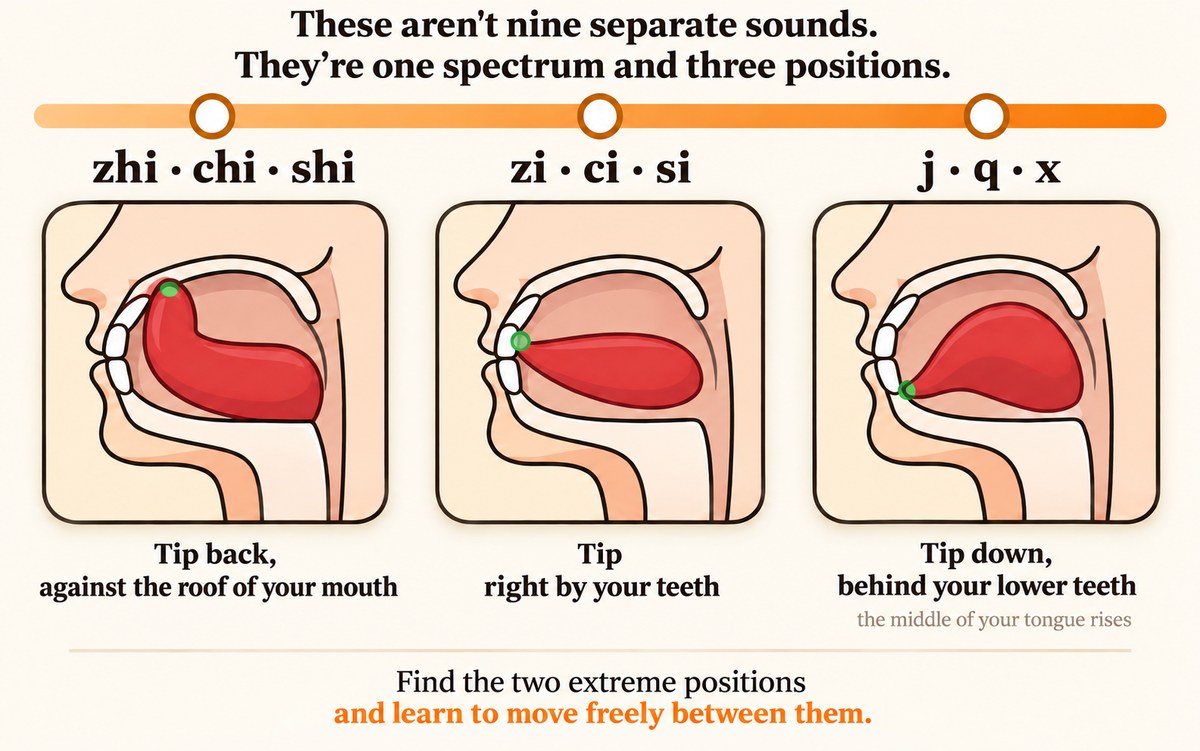
- To pronounce zh ch sh, move your tongue about ¾ of the way back (not all the way) and press the tip against the roof of your mouth. This is the starting position.
- Now for z, c, and s: put the tip of your tongue very close to your teeth.
I figured this out by trying the opposite: first, I understood that zh ch sh meant moving back. Then I thought, logically, what if I tried moving forward? And I got zi ci si.
What the spectrum looks like in practice
- zh ch sh (tip back against the roof of your mouth)
- z c s (tip toward your teeth)
- j q x (tip of your tongue down behind your lower teeth)
To understand this better, picture a slider like the ones we often use in mobile apps.
At one end, the tip of your tongue has moved back and pressed against the roof of your mouth. That’s zh ch sh. In the middle, the tip is right by your teeth. That’s z c s.
Next comes something that hardly happens in English: the tip of your tongue drops down and hides behind your lower teeth, while the middle of your tongue rises to do the work. That’s how you get j q x.
The most important thing is to avoid trying to learn the sounds individually. Find the two extreme positions, back against the roof of your mouth and down behind your teeth, and learn to move freely between them.
Check yourself: try placing a finger under your chin and saying sì → shì → xì.
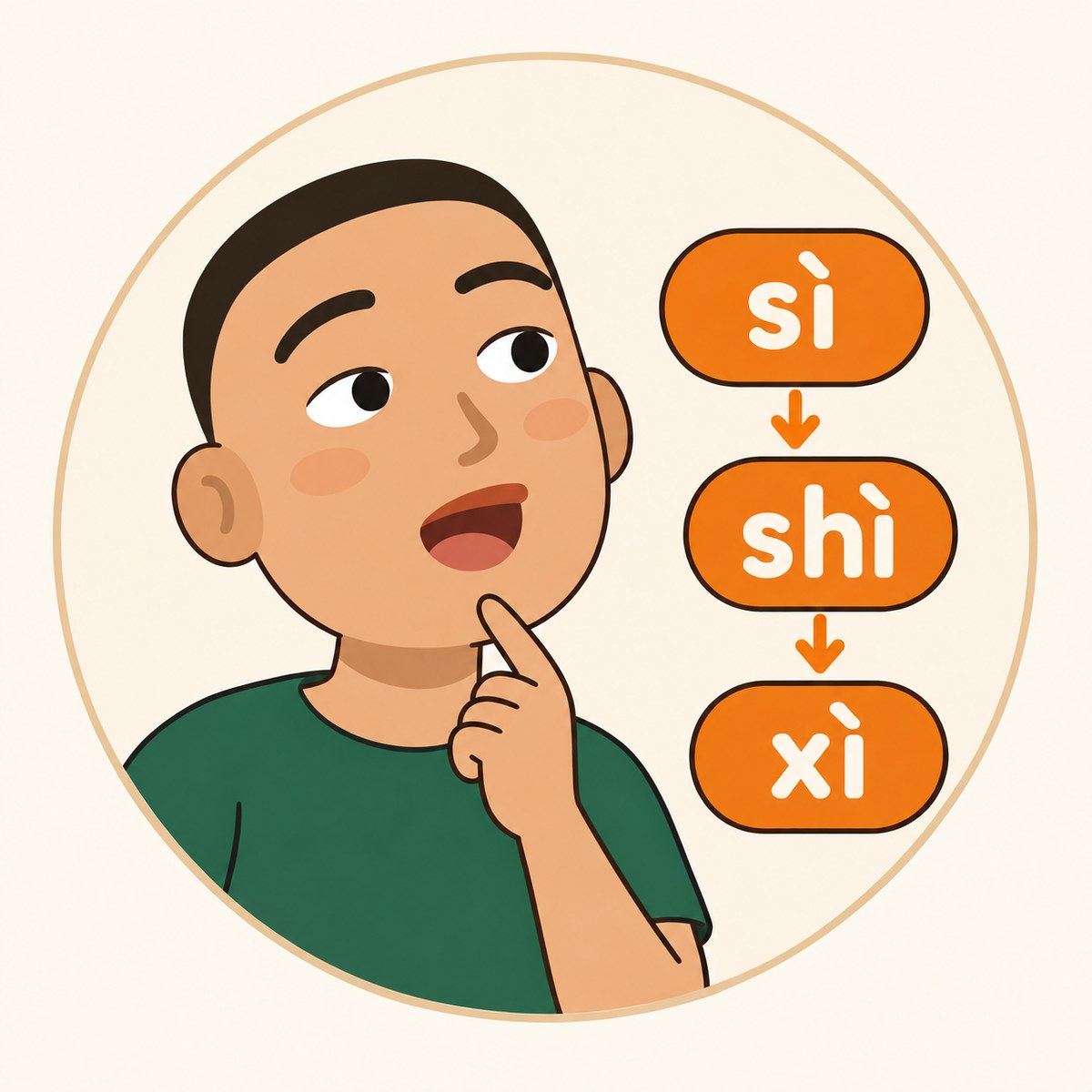
You’ll immediately feel three different tongue positions for these sounds. You can literally feel your tongue moving back and forth.
These sounds are usually taught as a list of nine sounds with a separate description of each, and our brains try to remember nine different pictures.
In my view, you need to understand one spectrum (an axis) and learn to “walk” freely along it from one end to the other.
j q x: the third tongue position
I’ll talk about j q x separately because it’s the trickiest of the three groups.
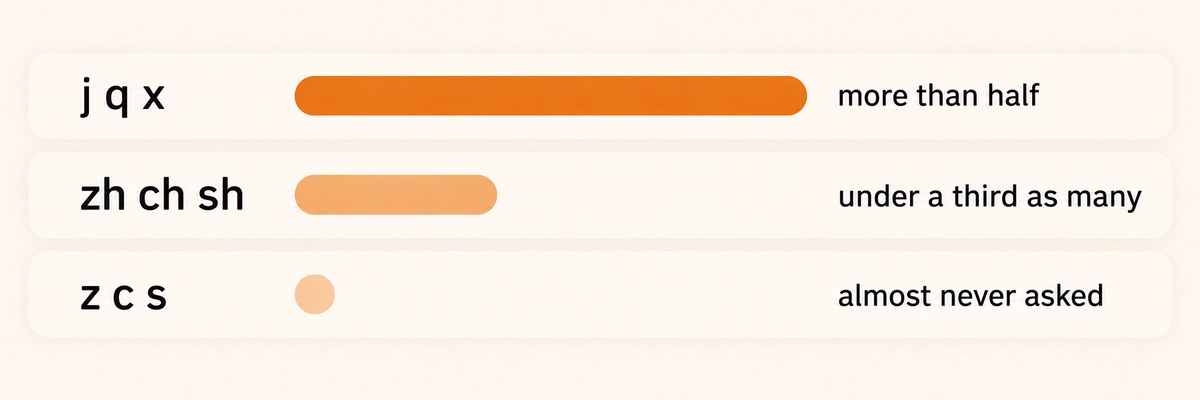
When I looked into what people were asking about Mandarin pronunciation, I was surprised that more than half of all learner questions were specifically about j q x. There were less than a third as many questions about zh ch sh, and z c s got no attention at all.
Take the syllable shi and the syllable xi. They sound almost the same. But inside your mouth, they involve two completely different positions.
- In shi, the tip of your tongue points up and back, toward the roof of your mouth.
- In xi, the tip of your tongue rests down behind your lower teeth, while the middle of your tongue rises toward the roof of your mouth.
Remember that in xi, the tip of your tongue doesn’t do any of the work. It just stays down.
The pairs ch and q, and zh and j, work exactly the same way.
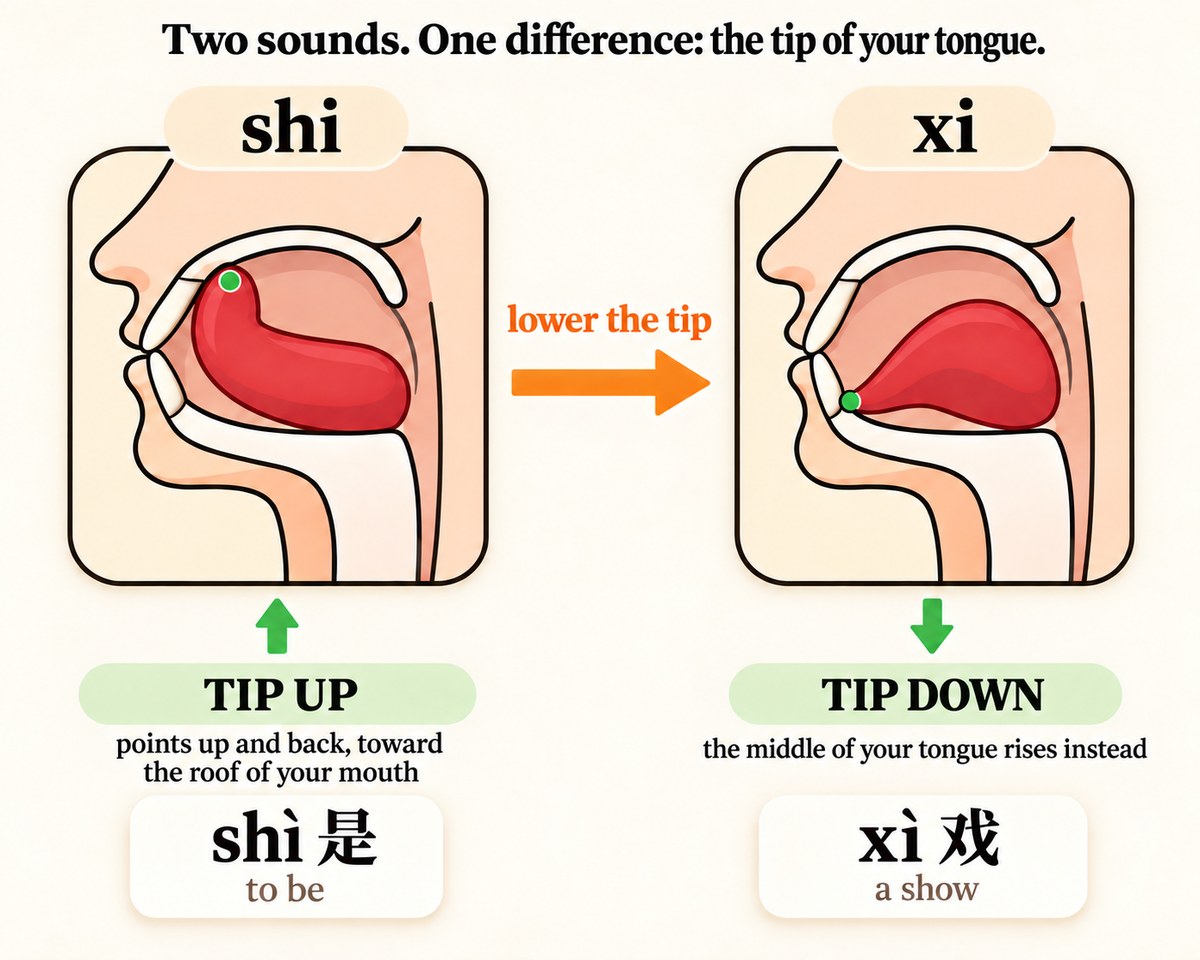
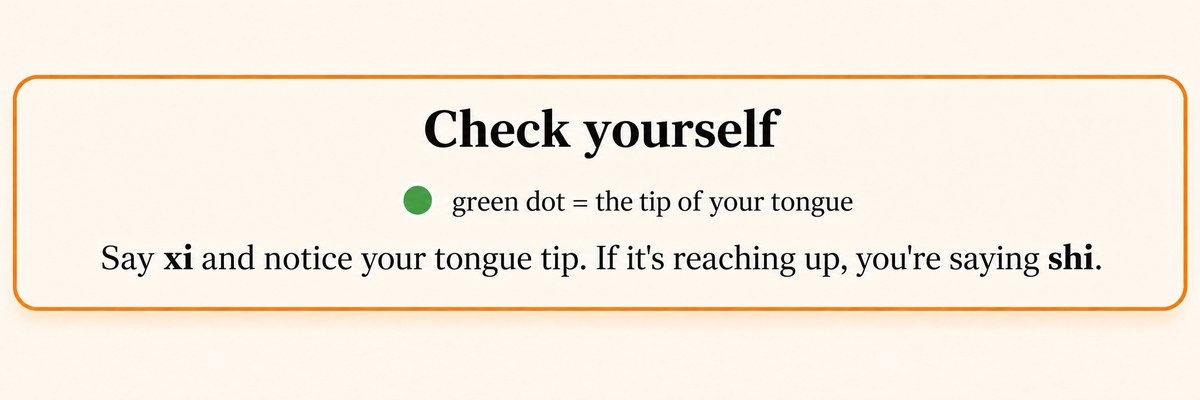
Here’s how to check yourself: say xi and notice where the tip of your tongue is at that moment. If it’s reaching upward, you’re saying shi, even if it doesn’t seem like it.
To get feedback and check if you’re making the right sound, you can try the practice widget with feedback here.