
My Chinese foundation before coming to China
Before I came to China, I spent two years taking group Chinese classes and also working with a phonetics tutor once a week.
At my first group class, I proudly took out the Sony tablet my dad had given me, opened Pleco, and did my best to show the teacher I was ready to learn.

Without batting an eye, the teacher told me to put the tablet away and go to the library to print out the textbook material they had on their computer.
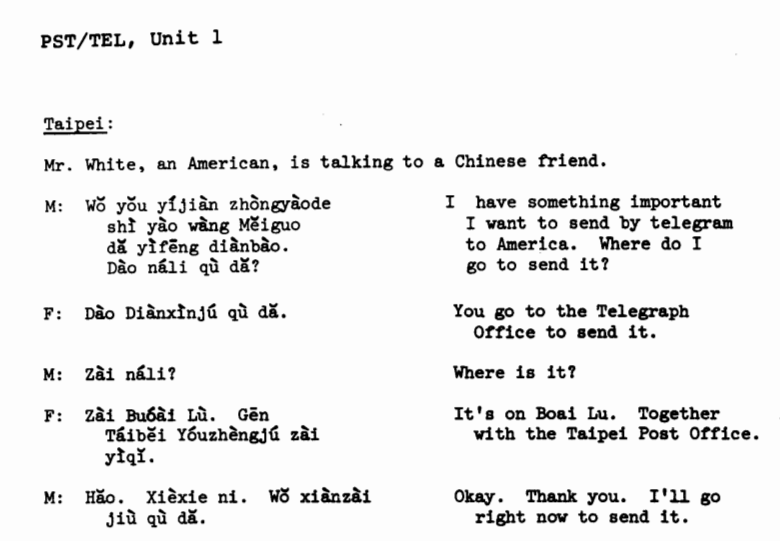
It turned out to be something like FSI’s Standard Chinese: A Modular Approach, written in the 1970s, and something like Practical Chinese Reader (1981).
The black-and-white pictures and Chinese characters looked like something from another planet. I felt a lot less excited about learning the language.
The teacher noticed that the whole group seemed down. She tried to cheer us up by saying that generations of students of Chinese had used these textbooks and that they gave you a great foundation to start with.
What followed was two years of exhausting rote memorization of short dialogues and speed dictations.
Sometimes I still mumble in my sleep, “I have something important I want to send by telegram to America,” haha, just kidding.
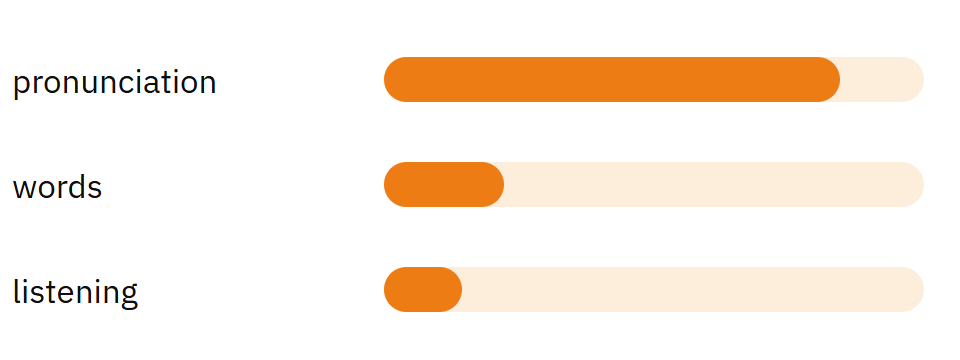
By the time I came to China, I had a good foundation in pronunciation, but I knew very few words and could barely speak.
Then I made a mistake. I got too confident in myself and my progress and stopped going to pronunciation lessons for the last six months before leaving for China.
As I found out later, I shouldn’t have done that.
This is how I felt about my Chinese skills after a year and a half of group classes and lessons with a phonetics tutor:
Why that foundation wasn’t enough
After my first reality check, my conversation with the taxi driver, I caught myself thinking: “I can say a few things (at an HSK1 level), but I can’t understand what people are saying.”
I also noticed that skipping pronunciation lessons for the last six months had caught up with me. I was mixing up zhi chi shi zi ci si again.
I managed to fix this by practicing regularly with a Chinese friend. I wrote more about it in this article.
A year at the university: why nobody corrects you
There were so many students at the university that the teachers simply didn’t have time to correct every foreign student’s pronunciation.
I was glad I’d arrived with at least some foundation in pronunciation. It turned out to be the main reason I made fast progress later.
For the first six months, I lived in training camp mode. My daily route was limited to three places:
- The dorm
- The classroom building
- The dining hall
Sometimes I went to play basketball or to the gym. But that was rare. For the first six months, I had to study for 10 hours a day.
About five or six hours went to classes with a teacher. I spent about the same amount of time doing homework and working on pronunciation on my own.
I still remember the teacher telling me I wasn’t spending enough time writing Chinese characters and that they looked like a child’s scribbles. In response, I made a big show of holding up my finger. It had a bloody blister from the pen I used to write characters.
Looking back, I realize that was a pretty dramatic scene, haha.
This is pretty much the face I made at the teacher when she said I wasn’t “writing out characters enough”

I was really motivated at the time. After the language program, I wanted to go straight into the second year of a bachelor’s program at BLCU.
To do that, I had to jump from HSK1 to HSK5 in about nine months.
That was when I would actually fall asleep over my textbooks in the library. A security guard would wake me up on his rounds before closing.
I did end up passing the exam, but exactly how I prepared for the HSK is a story for another post.
The main thing I learned early on: you have to help yourself and not rely only on teachers. Work on pronunciation on your own or with a phonetics tutor.