
Huang Pronunciation
Say Huang as “hwahng,” with a real h before the w, one syllable, with your voice rising like a question. You’ll often hear “wahng,” which drops the h at the start. That turns it into Wáng (王), a different family name. The vowel is the “a” in “father,” not the “a” in “hang.”
The tone picks the word: rising, it’s 黄 (huáng), “yellow”; dipping, it’s 谎 (huǎng), “lie.” Pick a word in the box above, tap the speaker to listen, then record yourself. The widget shows which tone it heard.

Huang, Wong and Hwang
Huang is the Mandarin spelling of 黄 (黃 in traditional characters), the one you’ll see for names from mainland China and Taiwan. Hwang is the Korean reading of the same character.
Wong comes from Cantonese, so you’ll see it a lot in Hong Kong and in long-established Chinese communities overseas. It often stands for 黄 too, but it’s also the Cantonese spelling of 王 (Wáng).
If a friend spells it Wong, ask how they say their own name, since it may not be the Mandarin huáng.
Three sounds in one beat
Huang is h, then a quick u, then “ang,” all in a single syllable, not “hoo-ang.”
- For the h, lift the back of your tongue toward the soft back part of the roof of your mouth and push air through the gap. You’ll hear a light rasp, like a softer version of the “ch” in German “Bach.”
- Round your lips for a quick “w,” as in “want.”
- Open into the “ah” of “father,” then close with the “ng” of “song.” The tip of your tongue stays down, and the back of it rises to touch the soft palate.
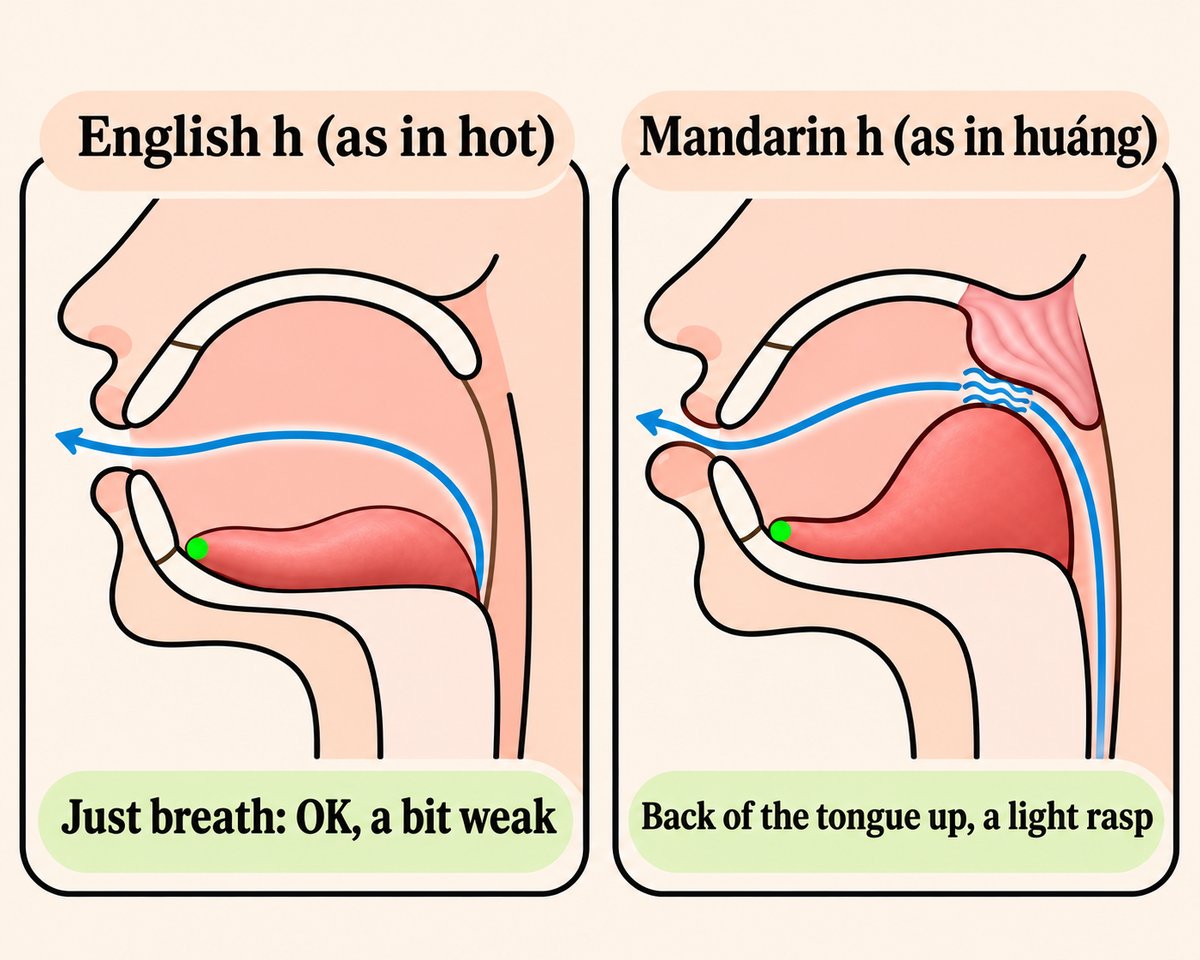
A plain English h is one of the normal ways to say it, just a little weak, and people will understand you. The vowel and the tone matter more.
Huang or Hong?
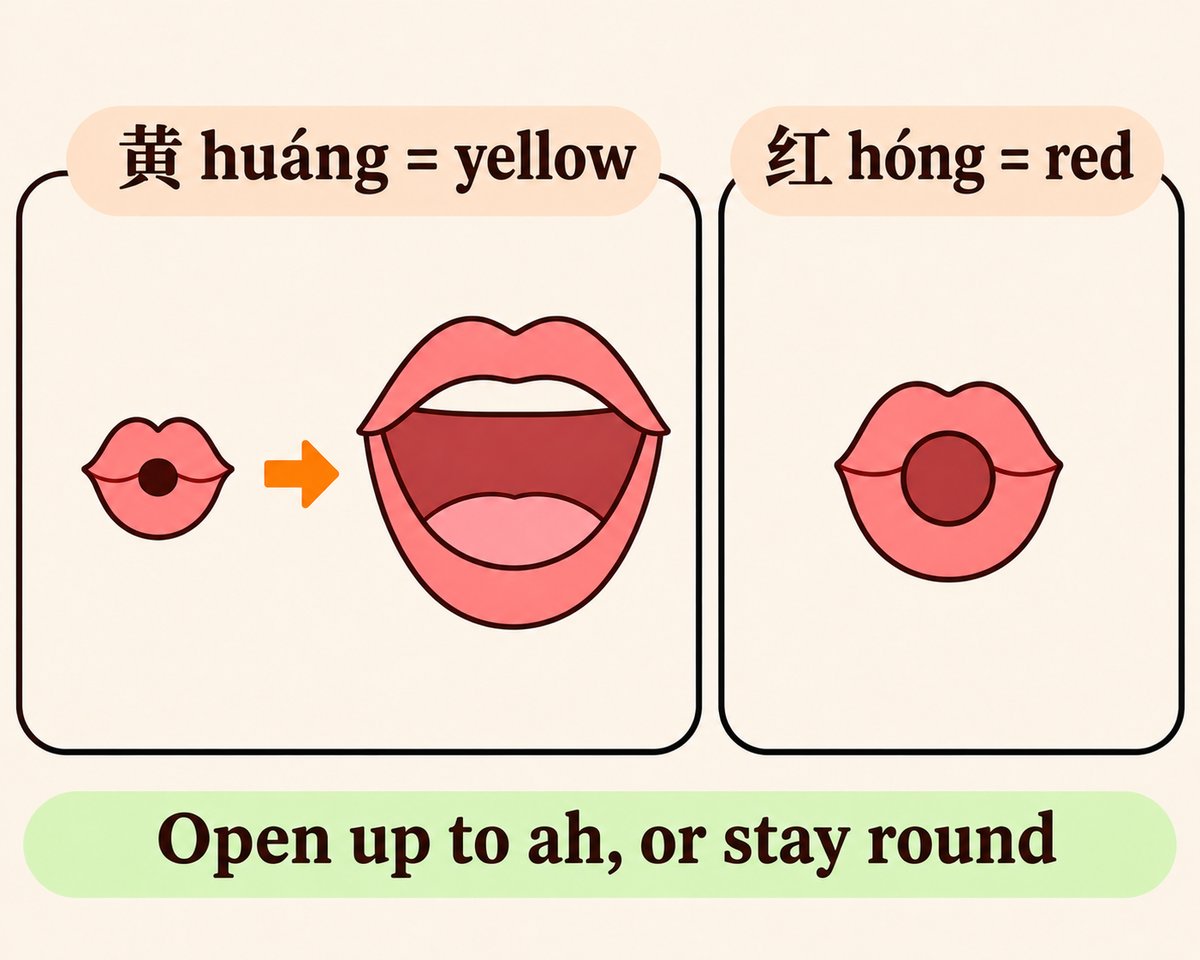
They’re different syllables. In 黄 (huáng), “yellow,” your lips start round and then open wide for “ah.” In 红 (hóng), “red,” they stay rounded the whole time, on a short “oo” like in “book,” before the ng. Both rise, so the shape of your mouth is what tells them apart.
Careful with the English way of saying “Hong,” as in Hong Kong: it often comes out as “hahng,” which is almost huang without the w.
Make it rise
Same sounds, four characters:
- 黄 (huáng), rising: “yellow,” and the family name
- 皇 (huáng), rising: “emperor,” as in 皇帝 (huángdì)
- 慌 (huāng), high and level: “flustered,” as in 恐慌 (kǒnghuāng), “panic”
- 谎 (huǎng), low and dipping: “lie,” as in 谎言 (huǎngyán)
黄 and 皇 sound exactly alike, and context tells them apart. The picture shows huǎng said on its own; inside a word like 谎言, the dip mostly stays low without the climb back up. For the name, start in the middle of your voice and go up, the way you’d ask “huh?” when you didn’t catch something.
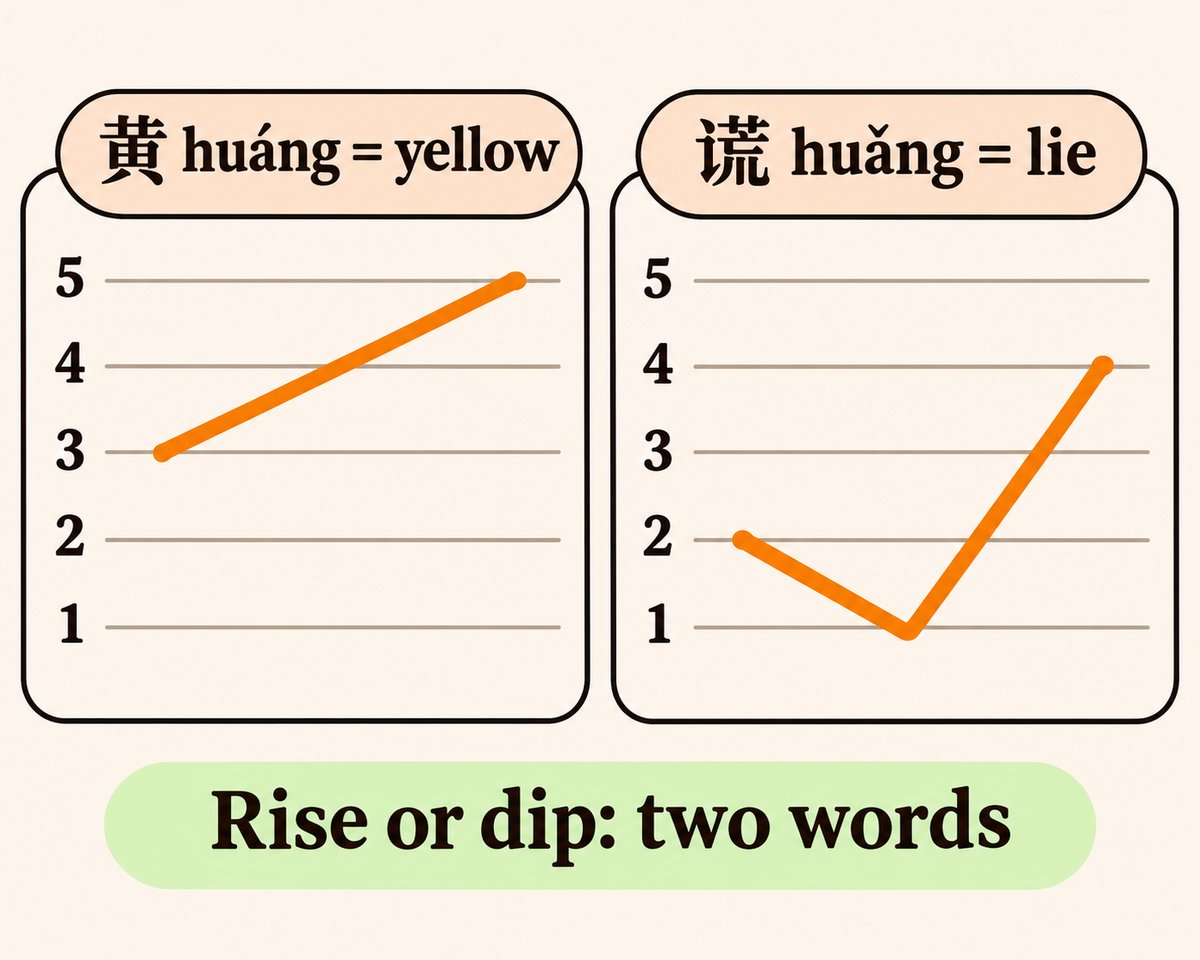
The tone chart plays all four tones in pairs, so you can hear the rise next to the dip.
Ten words to practice
The widget lists ten words with huang, most used first. Start with these three:
- 黄金 (huángjīn), “gold”: rise on huang, then stay high on jin.
- 皇帝 (huángdì), “emperor”: rise, then fall.
- 恐慌 (kǒnghuāng), “panic”: here huang is high and level.
More syllables English speakers find tricky: xia and qin. The rest are on the pronunciation guides page.